
Remote work proved something important. People can be productive from anywhere.
If companies want employees back in the office, the workplace has to work better than home. Especially when it comes to meetings, communication, and collaboration.
Because here is the truth: bad meetings kill return-to-office momentum faster than anything else.
When conference room technology fails, meetings start late, hybrid employees feel left out, and collaboration becomes frustrating. That experience makes employees wonder why they commuted at all.
If the office is going to earn the commute, it has to deliver something home cannot. And that starts with AV integration that simply works.
Bad Meetings Undermine Return-to-Office Efforts
The return-to-office conversation often centers around culture, connection, and collaboration. But those things break down quickly when meeting room technology does not support them.
We have all experienced it.
The camera will not connect.
No one can hear the remote participant.
The screen share fails.
Five minutes turn into fifteen.
Momentum disappears before the meeting even begins.
When conference rooms are inconsistent or overly complicated, employees default to what feels easier: taking the meeting from home.
A modern workplace technology strategy eliminates those friction points. Meetings should start on time. Audio should be crystal clear. Camera framing should feel natural. Room controls should be intuitive.
If people have to troubleshoot every time they gather, the office loses its advantage.
The Conference Room That “Just Works”
 The most effective workplaces today are designed around a simple goal: make meetings effortless.
That requires thoughtful AV integration, not just bigger displays.
A conference room that just works includes:
-
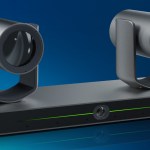
Intelligent cameras with auto-framing
-
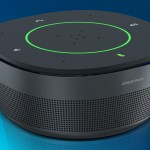
High-quality microphones that capture every voice clearly
-
Distributed speakers for even sound
-
Simple touch-panel room control
-
One-touch join functionality
-
Digital scheduling panels outside the room
When the technology disappears into the background, collaboration becomes the focus.
And that is the difference. The best workplace technology does not draw attention to itself. It removes friction.
Collaboration Spaces That Inspire Better Work
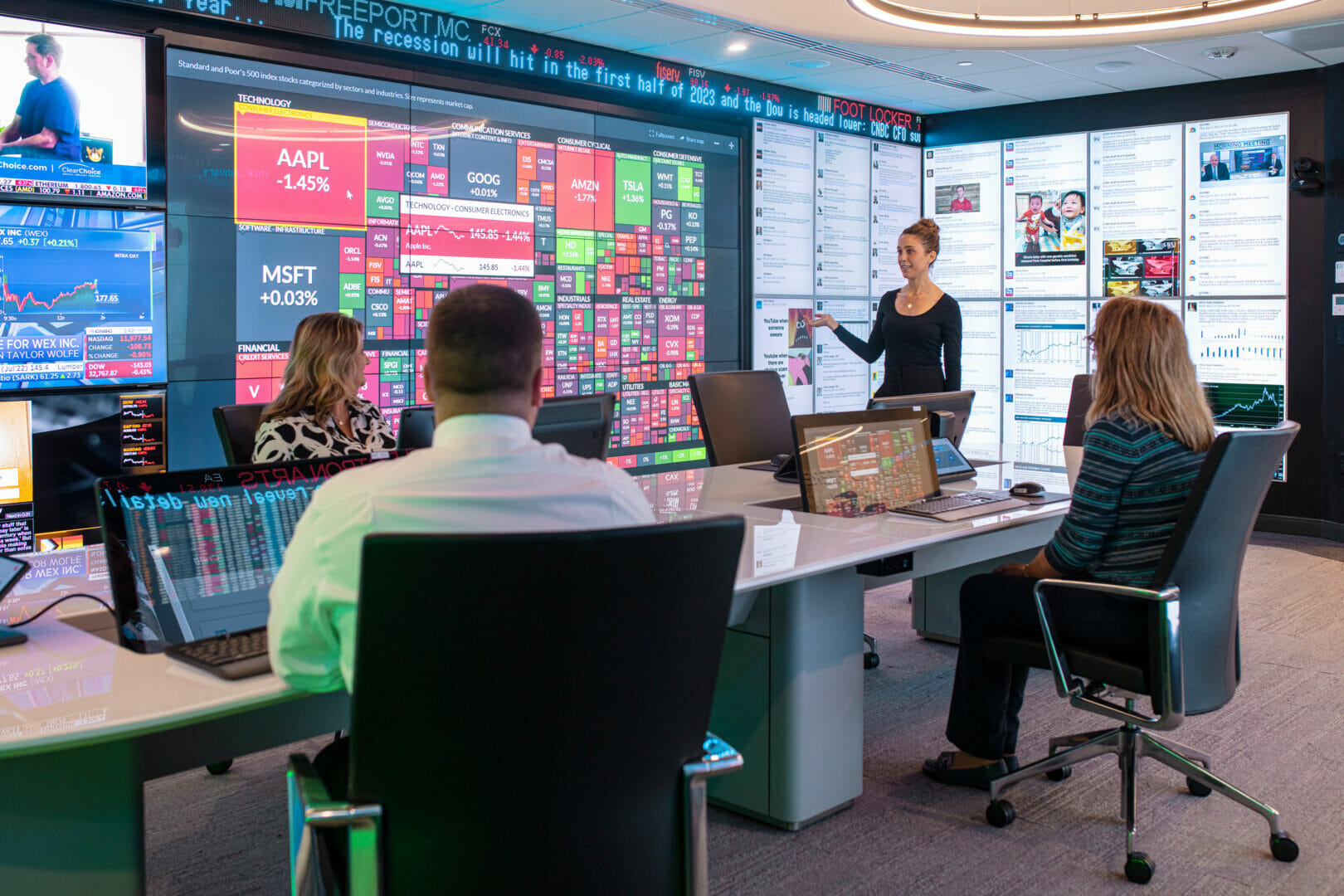
The Venture Visionary Lab
If the office is going to earn the commute, it has to offer something employees cannot recreate at home: spaces designed specifically for collaboration.
Modern workplaces are moving beyond traditional conference rooms and creating environments where teams can gather, explore ideas, and interact with information in real time. When collaboration spaces are designed intentionally, technology supports the conversation instead of slowing it down.
A great example is The Venture Visionary Lab at Venture Visionary Partners. Built as a high-tech research and collaboration environment, the space allows financial analysts and advisors to track market trends, compare investment strategies, and interact with complex data visually and in real time.
The lab features:
-
An 18′ x 6′ interactive LED video wall with a 32-point touch system
-
Multi-touch LCD video walls for side-by-side data comparison
-
Display technology designed for real-time analysis and group collaboration
Instead of individuals working separately on laptops, the space brings teams together around shared information. Analysts can manipulate data directly on the displays, visualize trends, and collaborate more effectively when making strategic decisions.
Spaces like this highlight what the modern office does best: bringing people together around tools and technology that make teamwork easier, faster, and more engaging.
Standardized Room Tiers Create Consistency
Another critical factor in workplace AV integration is standardization.
If every room functions differently, adoption suffers. Employees should not have to relearn the system every time they walk into a new space.
A strong workplace technology strategy often includes defined room tiers:
Huddle Rooms
-
Compact displays
-
All-in-one video bar
-
Wireless presentation
-
Simple touch control
Medium Conference Rooms
-
Dedicated cameras with auto-framing
-
Ceiling or table microphones
-
Integrated speakers
-
Scheduling panel outside the room
Boardrooms and Large Spaces
-
Multi-camera systems
-
Beamforming microphone arrays
-
Distributed audio
-
Advanced room control systems
-
Integrated collaboration platforms
When these room types are standardized, the experience remains consistent across the workplace. That consistency builds confidence and increases usage.
Technology Adoption Is the Final Piece
Even the best AV system fails if employees do not know how to use it.
Workplace AV integration must include training and change management. Clear instructions. Quick-start guides. Consistent interfaces across rooms.
When every conference room works the same way, adoption increases.
When meetings start smoothly, employees notice.
And when collaboration feels easier in the office than at home, the commute starts to make sense again.
The Office Must Offer an Upgrade
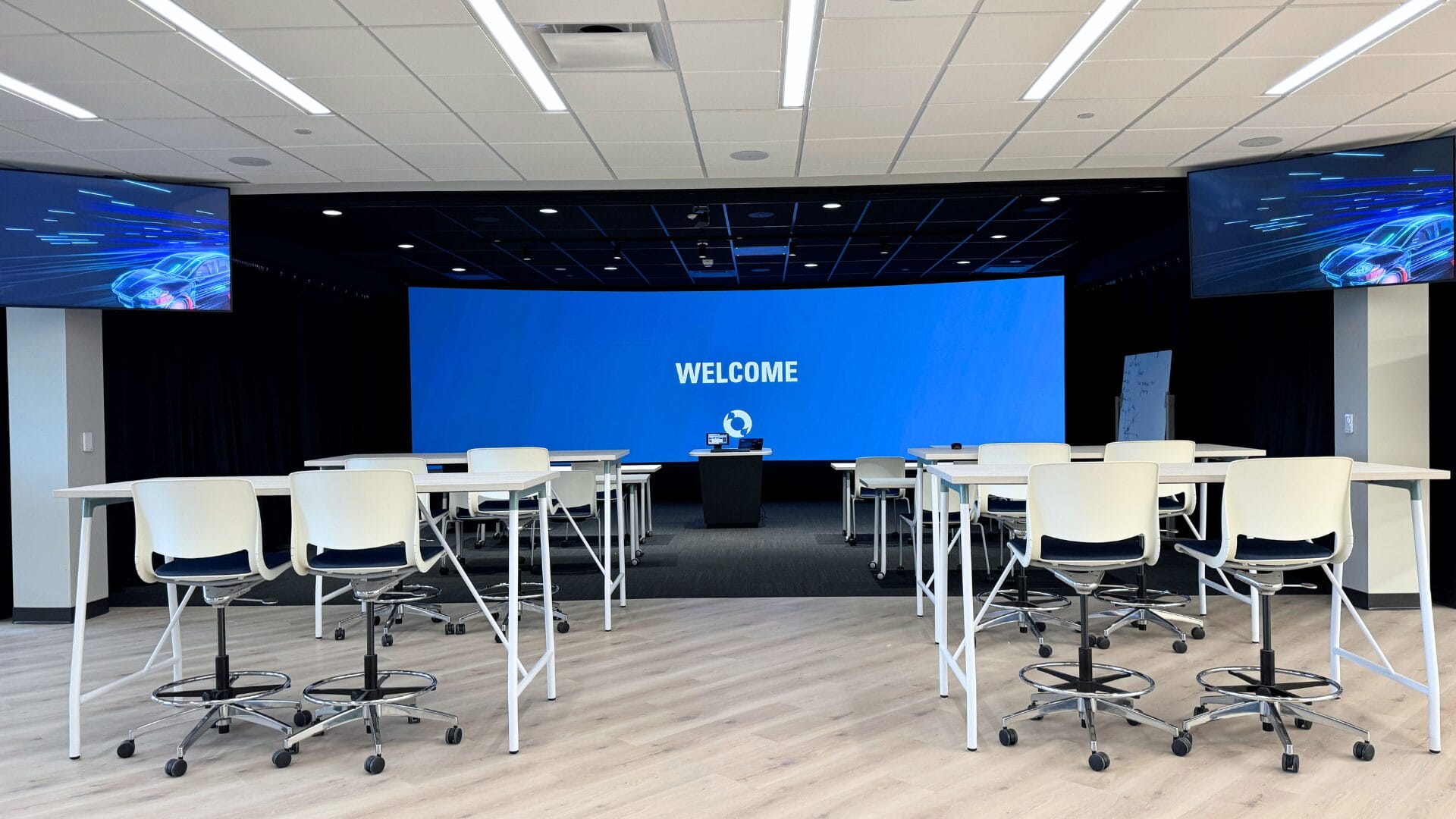
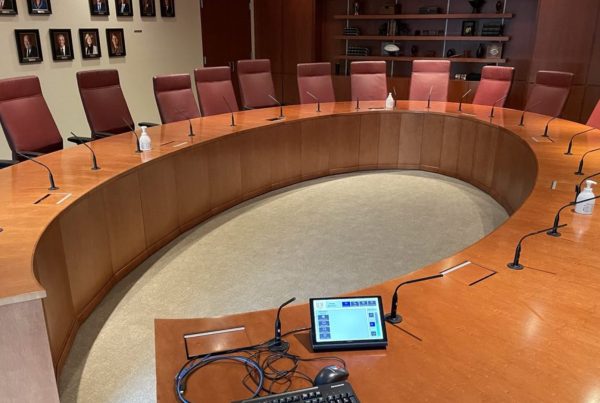
TI Fluid Systems Meeting Space
The office cannot compete with convenience. It has to compete with experience.
Employees will come in for connection, creativity, and collaboration. But only if the environment supports those goals.
The workplace has to earn the commute.
And that means designing AV-integrated spaces where meetings start on time, hybrid participants feel equal, and technology fades into the background.
Because when conference rooms just work, teamwork does too.
How Bluewater Designs Workplaces That Work
At Bluewater Technologies Group, we design and integrate workplace AV systems that eliminate friction and elevate collaboration. From standardized room tiers to hybrid meeting equity strategies, our team ensures your conference rooms support the way people actually work.
If you are rethinking your return-to-office strategy, let’s start with the technology that makes it successful.
Contact us today to begin designing a workplace that earns the commute.